Electronic Dance Music in Context
Annotated Bibliography
Selected articles and monographs on the subject of house and techno music. Exploring aesthetics, culture, and identity.
Annotated Bibliography
Selected articles and monographs on the subject of house and techno music. Exploring aesthetics, culture, and identity.
Annotated Bibliography
A collection of books relating to themes of contemporary library design and the "experience economy."
Research / Essay
An investigation into the historical and social contexts that guided the design of the Malmö City Library in Sweden.
Research / Essay
Explores the history of the library as a venue for experience and inspiration.
The following books are drawn together as a set of resources that respond to the question of the role of the library building in the changing economies of use and desire that surround today’s information culture. In an age of digital information ostensibly accessible to all, the library is no longer as widely considered the one true home for the pursuit of the world’s knowledge, and has had to employ a range of different arguments to justify its existence to those who see the internet as a valid replacement. The texts below reveal the history of the library’s function, assess the current role of the library in our information age, and point toward some ideas of the changing role the library may play in the future, paying particular attention to the types of “experience” a physical library space affords.
 |
[book] Institutions of Reading: The Social Life of Libraries in the United States. Amherst, MA: The University of Massachusetts Press, 2007.
This collection of essays explores the range of meanings libraries have held within their individual social milieus in the United States over the last several hundred years. Reflecting the concerns of a conference on the history of the public library held in 2002, each essay reflects a common theme that library service, and public perception of library service, is in a constant state of flux--no more so than now, though probably less exceptionally true now than we tend to think. Included are an essay by Roy Rosenzweig on digital preservation, a study of women writers in the libraries of the 1920s, and an essay on the early American libraries of colonial Philadelphia and New York.
Available from UIUC library. |
 |
[book] The Library as Place: History, Community, Culture. Westport, CT: Greenwood, 2007.
This collection of essays takes as its subject the idea of library as distinctive place, beginning with a discussion of how the term “place” has been deployed in academic discourse, as opposed to the term “space.” With a range of different versions of these concepts vitiating a set of essays organized into sections about the library’s place in the past, the role of libraries as places in the community, and the special qualities of research libraries, the collection includes investigations of undergraduate information behaviors, the use of libraries by LGBT communities, and the furnishings and designs of social libraries between 1800 and 1860.
Available from UIUC library. |
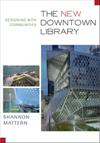 |
[book] The New Downtown Library. Minneapolis: University of Minnesota, 2007.
In an age of ambitious public library designs, Mattern explores the process of creation behind major projects in Seattle, San Antonio, Nashville, San Francisco, Phoenix, and Brooklyn. Not just focussing on the lauded intentions of architects and designers, the book dives into the heart of the design questions that surround the building of new libraries at the community level, involving citizens, patrons, journalists, and librarians. Mattern uses her detailed investigations of these projects to ask searching existential questions about the role of the library in the current age.
Available from UIUC library. |
 |
[book] Civic Space/Cyberspace: The American Public Library in the Information Age. Cambridge, MA: MIT Press, 1999.
As the title implies, the study here straddles the worlds of physical and digital libraries, investigating both the nature of librarianship in public library buildings across the U.S., and exploring the resources offered by libraries within the digital realm. Among the most significant questions the book poses is, what does it mean to be a librarian in the twenty-first century? The authors explore answers both by a theoretical approach and through interviews with working librarians.
Available from UIUC library. |
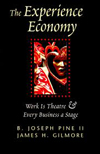 |
[book] The Experience Economy: Work is Theatre & Every Business a Stage. Boston: Harvard University Business School, 1999.
Written as a guidebook for business-owners, this economic study ushers in the then-nascent experience economy. Set apart from previous systems of economy which traded on goods and services, the experience economy appeals to consumers by creating immersive worlds to be explored, enjoyed, and, above all, remembered (fondly). For Pine and Gilmore, the experience economy is the latest stage in the capitalist narrative of charging a fee for what once was free, of “value-adding.” Though the authors focus on business, libraries do arguably exist in competition with, or at the very least in a world with similar expectations as, money-making enterprises such as bookstores and cafes, and so can benefit from similar strategies, and suffer from similar consequences of non-participation.
Available from UIUC library. |
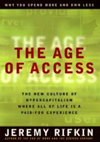 |
[book] The Ages of Access: The New Culture of Hypercapitalism, Where All of Life is a Paid-For Experience. New York: Penguin, 2000.
Where Pine and Gilmore see an opportunity to increase profits in the rise of the experience economy, Jeremy Rifkin sees an encroaching capitalism that threatens many of our most cherished cultural values. The new “age of access” is characterized by a move away from ownership and toward license. Instead of seeking to own property, businesses and individuals are more likely to seek short-term contractual arrangements, which in Rifkin’s view tend to favor big corporations who can afford to demand the terms most beneficial to them. Rifkin does not describe libraries directly, though his argument clearly has application in the world especially of academic libraries, in which increasing amounts of digital content are being licensed to libraries to use for set period of time, instead of purchased outright. In broader terms, though, it is possible to read Rifkin’s account of the increasing commercialization of culture while holding the library in mind as a sort of case-study, or even antidote.
Available from UIUC library. |
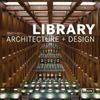 |
[book] Library Architecture + Design. Salenstein, Switzerland: Braun, 2011.
Part of the “masterpieces” series, Roth’s compendium brings together photographs and short descriptive texts of small and large libraries from around the world. The focus is on the “cutting edge” of library design, and includes both massive, large-scale projects such as the National Library of Beijing, but also tiny “single-person” libraries, such as the Scholar’s Library in Olive Bridge, New York. All libraries are illustrated with large interior and exterior photographs.
Available from UIUC library. |
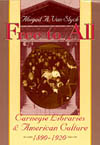 |
[book] Free to All: Carnegie Libraries & American Culture, 1890-1920. Chicago: University of Chicago, 1995.
Van Slyck explores the library building project founded and funded by Andrew Carnegie that produced large numbers of public library buildings in the late nineteenth and early twentieth centuries. Van Slyck explores the ways in which the Carnegie project redefined the role of the library in public life, not to mention the role of the librarian with it. Van Slyck also investigates the “cultural politics” of small-town and large-city public libraries, the roles of men and women in libraries, and recounts the childhood memories of many contemporary writers and memoirists have of their early experiences in Carnegie libraries, an iconic image on the small-town American landscape.
Available from UIUC library. |